Training
TNVC TRAINING AND EDUCATION TEAM
At TNVC we recognize that while night vision, thermal, and other Visual Augmentation Systems (VAS) technologies are a potent tool and force multiplier for our Warfighters, law enforcement personnel, hunters, and private citizens who are dedicated to defense of self and nation.
We also recognize, however, that the technology alone without the proper education and training to employ it, is not enough. For this reason, while we continue to strive to bring the very best of technology available to end-users and consumers of all types, we have never believed in “hardware solutions to software problems.”
Developed by experienced military and law enforcement officers, our training curriculum incorporates the best practices and lessons learned from years of experience in low and no light operations, planning, and training. Every member of TNVC’s Training and Education Team has used NV and other sensor systems in a variety of situations; from overseas combat, domestic LE/SWAT operations, hunting and recreational shooting, and understands the true importance and decisiveness of good training and knowledge in arriving at positive outcomes.
Our Team’s diverse real-world experience and flexible, adaptable curriculum allows the Training and Education Team to provide specific and specialized training that is relevant, realistic, and practical to students. Students that are confident in their gear selection, competent in its application, and capable in achieving their desired result(s) are goals for our graduates.
Please reach out to training@tnvc.com with any course specific questions, thanks!
If you are interested in training with our signature TNVC Training targets, you can get them here:
MEET THE TRAINING TEAM
Joe Halloran
Director of Training

Joe originally joined the TNVC Team in 2021 as an Adjunct Instructor with our Training and Education Team following his retirement from his combined NCO and officer thirty-two-year career in the United States Army. Serving as a Field Artilleryman as a Joint Fire Supporter and weapon delivery leader, providing joint fires in support of maneuver at all levels of combined arms operations. Joe has multiple operational and combat tours to the Balkans, Iraq, and Afghanistan and has led organizations from the Team to Brigade level, including Battery and Battalion Command, Brigade Deputy Commander.
Ian Gilchrist
LE/Military Training & Support

Ian joins TNVC after a thirteen-year career in the U.S. Navy, including twelve years as a member of Naval Special Warfare (NSW). After joining the Navy in 2009, Ian attended Basic Underwater Demolition/SEAL (BUD/S) in 2010 as well as attending the demanding Special Operations Combat Medic course (SOCM) before being assigned to SEAL Team 7 in 2012. During his time at SEAL Team 7, Ian has deployed multiple times to Middle East, and was most recently assigned to Naval Special Warfare Training Detachment Group One from 2017 to 2022 as an Assault Cell and Close Quarters Combat (CQC) Instructor.
Ephraim Rogers
MECOM and Training Team

Ephraim Rogers joined TNVC after completing the DoD’s SkillBridge program with TNVC and having recently retired after 25 years in United States Army and Army National Guard, as our Marketing, Education and Communications Operations Manager (MECOM) and Training Team member. Having most recently served as the Command Sergeant Major for the National Guard’s Warrior Training Battalion (ABN) at Fort Benning, Georgia, he was responsible for overseeing all Pre-Ranger, Air Assault, Jumpmaster, Pathfinder, and all levels of Master Gunner courses for both Active and Reserve component forces. Ephraim brings extensive experience managing professional level training and education programs at a senior level, and his previous assignments have included being the Senior ARNG Enlisted Advisor for the Army Center of Initial Military Training (CIMT), as well as the Army National Guard Bureau, Muscatatuck Urban Training Center, Army Airborne School at Fort Benning, Georgia, and the Professional Education Center in Little Rock, Arkansas, as well as extensive end-user experience, having been mobilized for combat duty for Operation Desert Spring, Operation Enduring Freedom, and Operation Iraqi Freedom.
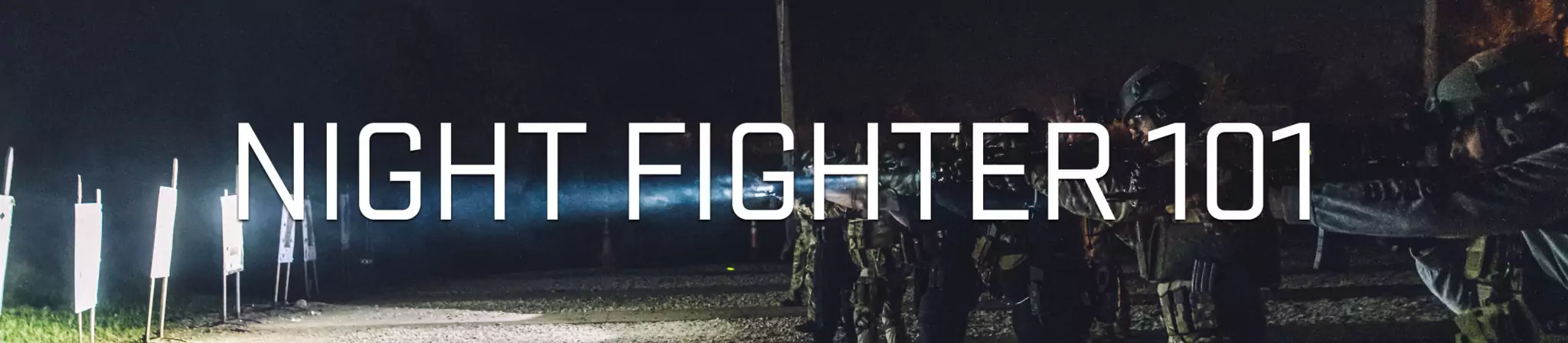
Night Fighter 101 is a two night training event designed to arm students with a solid understanding of the fundamentals of night vision operation and use. Beginning with gear choice and setup, the class provides students the tools for learning to safely and effectively move, shoot, and communicate in low-light / no-light environments. Students participate in a variety of movement, stalking, and live-fire exercises aimed at producing a core competency with night vision goggles, lasers, and white light.
SUBJECTS COVERED
Safety Brief
Gear Discussion (NV101)
Physiology of NV
Fundamentals of Night Ops
White Light drills
Zeroing Lasers
Square Range Shooting Drills
Reloads in the Dark
Transition Techniques
Moving and Shooting
Scenario Drills
Outdoor Movement with NV
Improvised Shooting Positions
Equipment Failure Drills
White Light/Night Vision Integration
PREREQUISITES
In accordance with ITAR regulations, only U.S. Citizens will be accepted to participate in TNVC courses, NO EXCEPTIONS. Proof of citizenship is required during the application process. NF 101 Students must have basic tactical weapons handling skills prior to the class. As such, students are required to provide proof of successful completion of a tactical carbine and pistol course, current/previous military or law enforcement training, and either proof of CCW or background check. Concealed Carry training does not meet the criteria for previous training.
To ensure you meet prior training requirements, please email: training@tnvc.com
- Carbine-mounted Weapon Light
- Red Dot (preferable Night Vision compatible)
- Infrared Laser (Rental Available)
- Weapon-Mounted IR Illuminator (recommended)
- Sling (2 point adjustable recommended and preferred)
- Serviceable Pistol (with red dot preferred)
- Pistol-mounted Weapon Light
- 650 rds Rifle (NO GREEN TIP)
- 250 rds Pistol
- Night Vision Goggle (Gen3 preferred, Rental Available)
- Helmet with Night Vision Mount (Rental Available)
- Handheld White Light
- Ballistic Eye Protection
- Ear Protection
- Maintenance/Cleaning Kit for Weapons
- Minimum of Five (5) Serviceable Rifle Magazines
- Minimum of Three (3) Serviceable Pistol Magazines
- Pistol Holster and Magazine Pouches that will retain items during movement
- Must hold two (2) each Rifle and Pistol Magazines on Person
- Sufficient Batteries for all your equipment
- IFAK or BOK on Person
- Clothing suited to strenuous activity as well as being seasonally appropriate
- Rain Gear / Cold Weather Gear (seasonal)
- Snacks, Energy Drinks, etc.
- Level 3 or 4 Rifle Plates and Appropriate Soft Armor (Not a requirement, plates and armor are recommended if used on duty as an armed professional)
- Pro Mask (Not a requirement, only are recommended if used on duty as an armed professional, and you’d like to get some reps in with duty gear)
- Any other Agency / Unit-specific tactical gear used on normal operations / callouts

Nightfighter 201 is a class for active-duty Military, Law Enforcement, Security Personnel, and Nightfighter 101 Graduates (or other equitable “level 1” night vision course). You must meet the pre-requisites, listed below, to attend this course.
Unlike Nightfighter 101 and other “Level 1” Night Vision based courses, Nightfighter 201 is a three night training event designed to provide advanced instruction to students who already are competent in low/no-light operations. This course focuses on building upon students’ already established skillsets in both individual and team settings for increased capabilities in a variety of different environments. Students will execute a number of tactical and skilled-based tasks including team movement and communication, target discrimination/engagement, advanced problem solving and individual/team tasks in an assortment of environments.
SUBJECTS COVERED
Safety Brief
Gear Discussion
Physiology of Night Vision
Zeroing Lasers
Square Range Shooting Drills
Reloads and Transitions
Improvised Shooting Positions
Equipment Failure Drills
White Light Integration
Team Movement
Non-Lethal Training Ammunition
Moving and Shooting
Visible Lasers
Pro Masks CBRN (as applicable)
Communication
IFF Signaling
Thermal Imagers
PREREQUISITES
In accordance with ITAR regulations, only U.S. Citizens will be accepted to participate in TNVC courses, NO EXCEPTIONS. Proof of citizenship is required during the application process. Nightfighter 201 students must have basic tactical weapons handling skills prior to class. As such, students are required to provide proof of successful completion of a tactical carbine and pistol course, current/previous military (combat arms MOS preferred) or law enforcement training, and either proof of current CCW or an LE/Gov background check. Concealed carry class does not meet the criteria of previous training.
Nightfighter 201 students must meet the above criteria and have proof of successful completion of a “level 1” night vision course (TNVC NF101 or equivalent), and/or have demonstrable current tactical military or law enforcement experience in low and no light operations.
To ensure you meet prior training requirements, please contact us at: training@tnvc.com
- Carbine-mounted Weapon Light
- Red Dot (preferable Night Vision compatible)
- Infrared Laser (Rental Available)
- Weapon-Mounted IR Illuminator (recommended)
- Sling (2 point adjustable recommended and preferred)
***LAW style folders and non GI style recoil assemblies are problematic with NLTA***
- Serviceable Pistol (with red dot preferred)
- Pistol-mounted Weapon Light
- 650 rds Rifle (NO GREEN TIP)
- 250 rds Pistol
- 60 rounds NLTA Ammunition (can be purchased on site)
- Night Vision Goggle (Gen3 preferred, Rental Available)
- Helmet with Night Vision Mount (Rental Available)
- Handheld White Light
- Ballistic Eye Protection
- Ear Protection
- Maintenance/Cleaning Kit for Weapons
- Minimum of Five (5) Serviceable Rifle Magazines
- Minimum of Three (3) Serviceable Pistol Magazines
- Pistol Holster and Magazine Pouches that will retain items during movement
- Must hold two (2) each Rifle and Pistol Magazines on Person
- Sufficient Batteries for all your equipment
- IFAK or BOK on Person
- Clothing suited to strenuous activity as well as being seasonally appropriate
- Rain Gear / Cold Weather Gear (seasonal)
- Snacks, Energy Drinks, etc.
- Level 3 or 4 Rifle Plates and Appropriate Soft Armor (Not a requirement, plates and armor are recommended if used on duty as an armed professional)
- Pro Mask (Not a requirement, only are recommended if used on duty as an armed professional, and you’d like to get some reps in with duty gear)
- Any other Agency / Unit-specific tactical gear used on normal operations / callouts